

 Have any questions? Call us:



Tom Pratt had worked as a labourer for Patrick Ditton since December 2015 on sites at Dubbo and on the NSW Central Coast. Ditton supplied labour to Williams River Steel Pty Ltd, the contractor controlling construction of a motor vehicle showroom at Pennant Hills Road in Sydney’s west. The company’s work included unloading steel beams and assisting steel riggers.
In June 2016, six I-beams were delivered by truck to the site at about 9 am. Each was 17.5 m long and weighed at least 750 kg. Gary Dries, – Ditton’s foreman – was also a licensed dogman: the person responsible for attaching loads, directing the crane and safely disconnecting slings.
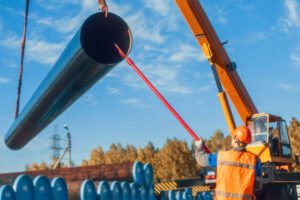
The beams were unloaded in pairs onto a driveway beside the showroom concrete slab. The final pair had not though settled flat on the ground: one beam was sitting on the other at one end.
When Dries called out, “They’re right”, Pratt understood those words as a direction that it was safe to approach and release the chains. He had no dogman training and did not appreciate the danger. Before the chains were removed, the upper beam became unstable and fell onto his lower left leg, foot and ankle.
Four metatarsals and three cuneiform bones in his left foot were fractured, with joint and ligament damage. He underwent a lengthy course of surgery and suffered chronic pain, complex regional pain syndrome, ankle instability, falls, low back pain, depression, anxiety and post-traumatic stress disorder.He did not return to any form of work.
His injury compensation claim came to the NSW Supreme Court before Justice Des Fagan who treated much of Pratt’s recollections cautiously. There were substantial differences between his earlier written statements and his testimony from the witness box. Several details first he first advanced many years after the event were rejected.
That said, the judge accepted his account of the central facts about how the injury occurred because it aligned with objectively established features of the event and the surrounding probabilities.
The court examined what could reasonably have been expected under the employer’s ordinary duty to take reasonable care to avoid unnecessary risks to employees. It concluded that the risk of injury to a worker approaching heavy beams if they were unstable after the lifting chains slackened needed to be guarded against.
A reasonable system of work required – so ruled the judge – a qualified dogman to inspect the load from a safe position immediately after it was placed down, before anyone came close. If the beams were unstable, they could have been raised and resettled.
The court also found that other workers should have been told not to approach until the dogman had confirmed stability and disconnected the chains. A visible barrier or a separate supervisor was needed to keep workers outside the danger area.
None of those precautions had been taken. Dries’ positive direction to Pratt toward the uninspected load was an additional and separate breach.
The court concluded that had reasonable care been taken, Pratt would not have been in the position where the beam could fall on his foot.
The employer also alleged contributory negligence, but failed to establish it. Pratt had approached in obedience to his immediate supervisor’s direction, rather than ignoring a warning or instruction. The court made no reduction to damages for contributory negligence.
In assessing damages, the judge accepted that the continuing effects of the injury prevented a return to labouring and other mobile physical work, while back pain, limited literacy, low intellectual capacity and lack of computer skills made a transition to sedentary work unrealistic. For practical purposes, Pratt’s future earning capacity had been entirely lost.
Pratt’s pre-accident work record was intermittent. To determine income loss, the court accepted a projected path of labouring followed by Level 2 welding work, but applied a 30% reduction to economic-loss calculations: the usual 15% allowance for contingencies plus a further 15% for the likelihood of irregular employment and lower-paid work.
The resulting figures included $519,000 for past loss of earnings and $847,000 for future economic loss. After deducting $388,000 in workers compensation weekly payments, the court entered verdict and judgment for Pratt in the net sum of $1,031,000.
Pratt v Ditton [2026] NSWSC 1041 Fagan J, 1 September 2026
Categories: Construction accident