
 Have any questions? Call us:



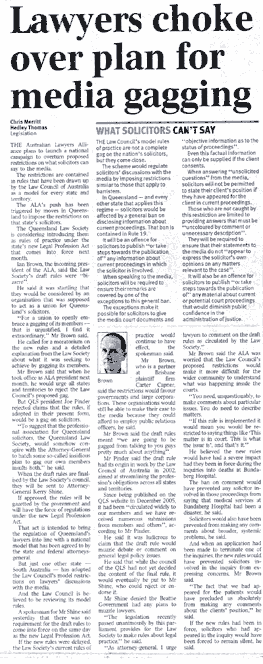
THE Australian Lawyers Alliance plans to launch a national campaign to overturn proposed restrictions on what solicitors can say to the media.
The restrictions are contained in rules that have been drawn up by the Law Council of Australia as a model for every state and territory.
The ALA’s push has been triggered by moves in Queensland to impose the restrictions on that state’s solicitors.
The Queensland Law Society is considering introducing them as rules of practice under the state’s new Legal Profession Act that comes into force next month.
Ian Brown, the incoming president of the ALA, said the Law Society’s draft rules were “bizarre”.
He said it was startling that they would be considered by an organisation that was supposed to act as a union for Queensland’s solicitors.
“For a union to openly embrace a gagging of its members – that is unjustified, I find it extraordinary,” Mr Brown said.
He called for a moratorium on the new rules and a detailed explanation from the Law Society about what it was seeking to achieve by gagging its members.
Mr Brown said that when he took office as ALA president next month, he would urge all states and territories to reject the Law Council’s proposed gag.
But QLS president Joe Pinder rejected claims that the rules, if adopted in their present form, would be a gag on solicitors.
To suggest that the professional association for Queensland solicitors, the Queensland Law Society, would somehow conspire with the Attorney-General to hatch some so-called insidious plan to gag our own members insults both,” he said.
When the draft rules are finalised by the Law Society’s council, they will be sent to Attorney-General Kerry Shine.
If approved, the rules will be gazetted by the government and will have the force of regulations under the new Legal Profession Act.
That act is intended to bring the regulation of Queensland’s lawyers into line with a national model that has been agreed to by the state and federal attorneys-general.
But just one other state – South Australia – has adopted the Law Council’s model restrictions on lawyers’ discussions with the media.
And the Law Council is believed to be reviewing its model rules.
A spokesman for Mr Shine said yesterday that there was no requirement for the draft rules to come into force on the same day as the new Legal Profession Act.
If the new rules were delayed, the Law Society’s current rules of practice would continue to have effect, the spokesman said.
Mr Brown, who is a partner at Brisbane plaintiff firm Carter Capner, said the restrictions would favour governments and large corporations. These organisations would still be able to make their case to the media because they could afford to employ public relations officers, he said.
Mr Brown said the draft rules meant “we are going to be gagged from talking to you guys pretty much about anything”.
Mr Pinder said the draft rule had its origin in work by the Law Council of Australia in 2002, aimed at streamlining the profession’s obligations across all states and territories.
Since being published on the QLS website in December 2005, it had been “circulated widely to our members and we have received numerous submissions from members and others”, according to Mr Pinder.
He said it was ludicrous to claim that the draft rule would muzzle debate or comment on general legal policy issues.
He said that while the council of the QLS had not yet decided the content of the final rule, it would eventually be put to Mr Shine, who could reject or endorse it.
Mr Shine denied the Beattie Government had any plans to muzzle lawyers.
“The legislation recently passed unanimously by this parliament provides for the Law Society to make rules about legal practice,” he said.
“As attorney-general, I urge lawyers to comment on the draft rules as circulated by the Law Society.”
Mr Brown said the ALA was worried that the Law Council’s proposed restrictions would make it more difficult for the wider community to understand what was happening inside the courts.
“You need, unquestionably, to make comments about particular issues. You do need to describe matters.
“If this rule is implemented it would mean you would be restricted to saying things like ‘This matter is in court. This is what the issue is’, and that’s it.”
He believed the new rules would have had a severe impact had they been in force during the inquiries into deaths at Bundaberg Hospital.
The ban on comment would have prevented any solicitor involved in those proceedings from saying that medical services at Bundaberg Hospital had been a disaster, he said.
Solicitors would also have been prevented from making any comments about broader, systemic problems, he said.
And when an application had been made to terminate one of the inquiries, the new rules would have prevented solicitors involved in the inquiry from expressing concerns, Mr Brown said.
“The fact that we had appeared for the patients would have precluded us absolutely from making any comments about the clients’ position,” he said.
If the new rules had been in force, solicitors who had appeared in the inquiry would have been forced to remain silent, he said.