

 Have any questions? Call us:



Alan McGrath was working alone west of Brisbane to assess hail damage to the roof of a residence following a a severe weather event that battered south-east Queensland on 31 October 2020 leaving a damage bill exceeding $1 billion.
After the storm he was sent by his employer Ezy Projects from office-based estimating into the field to inspect damaged roofs. The firm was small – with only two estimators – and the work for the insurance companies who appointed it, urgent.
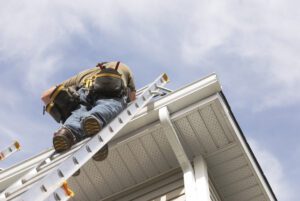
McGrath’s work-issued ladder had gone with another employee to Rockhampton. He discussed the lack of a ladder and a “ladder mate” with operations manager Matthew Rooney. A ladder mate is a low-cost device that hooks over a metal gutter and holds a ladder in place; unlike a strap, it can stay in place while the worker climbs down.
Rooney asked McGrath to use his own equipment temporarily while replacement gear was sourced.
It also emerged that the company had not provided working-at-heights training and had not as yet supplied McGrath with a ladder mate or the replacement ladder.
On site at the single-storey home he needed to assess for roof damage, he chose a personal stepladder to get to the roof rather than his extension ladder. The tall stepladder extended about 350 mm above the roof gutter and was not seated flush against it. He strapped it to the gutter while climbing up, but the strap had to be removed before his descent.
Then he fell – but could not not remember precisely how – and was badly injured.
The injuries included complex fractures around his right elbow, a right hip fracture and a spinal fracture. He had multiple operations, including a total right elbow replacement, later developed an infection requiring further treatment and underwent subsequent surgery to reconstruct his triceps insertion.
His injury claim in the District Court at Brisbane came before Judge Bernard Porter KC who reasoned that sending a second worker to every site was not economically viable as a safety precaution to ameliorate the risk of injury to a worker required to ascend and descend a ladder alone. But providing a ladder mate or a better ladder was a modest practical measure the employer could have taken.
In the judge’s view, had a ladder mate been supplied, McGrath would have used it and it would likely have prevented the fall.
Orthopaedist Kelly Macgroarty and psychiatrist Greg Apel considered that McGrath could – on their clinical assessments – have returned to some work by April 2024.
That though was subject to the claimant’s evidence about his continuing pain, disturbed sleep and functional limits. The judge accepted McGrath as a credible and reliable witness and agreed his fluctuating pain and the effects of pain medication substantially limited his capacity to drive, concentrate and work reliably.
The court was not persuaded that the remote estimating roles submitted by the insurer as being suitable, were viable for him on a flexible, part-time basis.
Was McGrath partly to blame for his own injuries? He could after all have purchased his own ladder mate from Bunnings. And selecting the stepladder involved a mistaken assessment by him of the risk.
In the judges view, McGrath had made a misjudgment rather than shown disregard for his own safety: he did not use a ladder that could not reach the gutter, choose an obviously dangerous location, or engage in deliberately risky conduct.
The insurer filed to discharge its onus of proving contributory negligence.
The agreed damages totalled $1,380 mil. It included $125,000 for generahail damagel damagel damages, past and future economic loss, superannuation, future treatment expenses and statutory amounts. After a $742,000 refund to WorkCover Queensland, judgment was entered for Mr McGrath for $637,000.
McGrath v Ezy Projects Pty Ltd [2026] QDC 121 Porter KC DCJ, 7 August 2026
Categories: Adequate System Of Work