
 Have any questions? Call us:



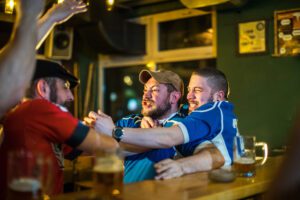
CCTV vision of an altercation at the Orient Hotel in The Rocks in Sydney in December 2022 showed a crowded bar with several separate groups.
It also showed Benjamin Hughes crossing the room – from where he had been standing with his wife – several metres towards Matthew Bramston with his arm outstretched. Bramston fell injured to the floor. The alleged trigger was that Bramston had taken a sip from the drink of Hughes’ wife.
Bramston suffered a fractured left leg and later underwent surgery. Hughes had pleaded guilty to common assault in related Local Court proceedings.
Bramston brought a claim for assault and battery against Hughes in the District Court.
The trial judge was not satisfied the alleged provocation had occurred and observed that the footage showed Bramston was not near Hughes or his wife at the time of the confrontation.
She considered Bramston had exaggerated aspects of his symptoms to medical practitioners and his capacity for some activities. But she accepted his evidence about the incident, particularly given the surveillance evidence as a whole.
Bramston succeeded in his claim with the trial judge awarding $513,000, including general damages, past and future economic loss, care and treatment expenses, $25,000 aggravated damages and $50,000 exemplary damages.
Hughes appealed on a number of fronts. He challenged factual findings about the contact and fall, argued that the trial judge had not properly dealt with self-defence, questioned the assessment of Mr Bramston’s credibility and disputed awards for care and past economic loss.
He also challenged the exemplary-damages award, which stemmed from the conduct of part of the defence case and the release of CCTV material to the media during the trial prior to its formal tender as an exhibit in breach of an undertaking in relation to evidence.
The appeal judges identified an error in the trial judge’s treatment of the self-defence argument in that the fact that Hughes’ conduct was intentional did not, by itself, prevent him relying on that that defence under the Civil Liability Act as opposed to self-defence at common law.
Self-defence was not however open as Hughes had failed to establish a belief that physical force was necessary to defend his wife from unlawful conduct and that the response was reasonable.
The appeal court also rejected Hughes’ broader factual and credibility challenges.
The appeal judges upheld $54,000 for past gratuitous domestic and personal care, supported by unchallenged occupational-therapy evidence, and $170,465 for past economic loss, supported by unchallenged actuarial calculations. It found no error in those assessments, even though the trial judge had also concluded that Bramston did not have a permanent incapacity and that his business could be revived over time.
The appeal succeeded though on the award of $50,000 that followed a finding that the CCTV footage had been supplied to a Channel 10 reporter before it was formally tendered, in breach of the ‘Harman’ obligation which restricts the collateral use of material produced under compulsion in litigation.
The Court of Appeal held that the evidence did not establish how the CCTV footage had been obtained, so there was no proper foundation for finding that the obligation applied.
It added that, even if an obligation had existed, the footage had been played in open court without a non-publication order before it was released. In those circumstances, its contents had already entered the public domain.
In the appeal judges’ view, the evidence did not prove that Hughes, his solicitor or the reporter had engaged in or authorised a campaign to improperly pressure Bramston as a litigant or witness.
The appeal was therefore allowed in part: the $50,000 exemplary-damages award was set aside, but the appeal was otherwise dismissed.
Hughes v Bramston [2026] NSWCA 153 Ward P, Mitchelmore and McHugh JJA, 30 July 2026
Categories: Entertainment venue injury