

An appeal court has held that an unpainted speed hump was not an “obvious risk” in a carpark where other hazards had been marked in yellow and that painting it was a simple reasonable precaution.
Grace Balacco worked for a doctor in a mixed use – commercial and residential – building in Sydney’s Bondi Junction, but was not a regular user of its level 2 carpark.
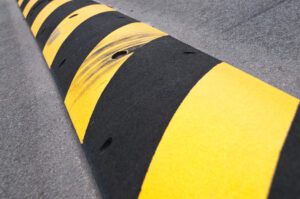
In May 2023, roadworks meant she had to move her car from the street into the building’s secure carpark. At the end of the day, shortly before 5.15 pm, she walked from the lifts towards the car and tripped on a curved concrete speed hump.
She fractured her right humerus. The hump, built with the building in about 1987, was about 65 mm high and 270 mm wide. It met the construction standards that applied when it was installed. But at the time of the fall it was the same grey as the surrounding driveway.
Every other feature of the carpark used conspicuous visual cues. Concrete columns, steps, wheel stops and other irregularities were marked in yellow or bright colours. There were only two speed humps, both near Balacco’s parking space and neither had been painted.
After her accident, the speed humps were later painted yellow and black so they stood out as a hazard.
She started an injury compensation claim in court.
The owners corporation argued in their defence that the hump was obvious: Balacco had driven over it and walked across it earlier that day, and speed humps are common in carparks.
The trial judge ruled against that contention. The law did not require a pedestrian to be constantly alert for obstacles on a carpark surface. Further, the widespread use of yellow paint to distinguish other features could direct a pedestrian’s attention towards the painted hazards and away from the unpainted ones. In those circumstances the risk of injury could not be said to have been “obvious”.
She awarded $385,000 in damages to Balacco.
The owners corporation appealed on the grounds of the obviousness of the speed hump risk. It also challenged the primary judge’s conclusion that the motion-sensitive lighting had not fully illuminated the carpark by the time she fell.
Justice Leeming concluded he did not need to decide the lighting dispute conclusively. He proceeded on the owners corporation’s preferred assumption that the lights were fully on. But even on that footing, he held that the unpainted hump did not – on an objective assessment – present an obvious risk for the purposes of the Civil Liability Act. The risk would not have been obvious to a reasonable person in the injured person’s position.
Prior encounters with the hump did not change that result, he ruled. Driving over a hump while manoeuvring a vehicle is different from perceiving it as a pedestrian. The court also noted the practical value of visual cues: people may forget features they encountered earlier in the day.
On breach, the Court accepted that the probability of a serious fall was low, and that the carpark was not open to the public. But the risk of tripping and falling on concrete was foreseeable, the likely harm was moderate, and the burden of precaution was trivial. Painting the two humps yellow would have brought them into line with the many other hazards already highlighted in the carpark. The failure to paint them was therefore negligent.
The Court accepted that a painted hump would still have been a hazard, and that Balacco might still have fallen. The legal question, however, was whether it was more probable than not that she would have avoided the fall if it had been painted.
The court concluded she would have been less likely to trip on a contrasting yellow hump, just as she had negotiated the other painted obstacles without incident.
Nor was there contributory negligence. Balacco’s evidence was that she was walking normally and was not distracted. There was no basis to say she had failed to keep a proper lookout, even though she had earlier driven over and walked across the hump.
The appeal judges did though reduce the damages awarded. In their view the allowance of $85,000 for future economic loss and super as a “buffer” for the possibility that Balacco’s injury would affect her future work was suspect in the absence of any stated probability or explanation of the assumptions behind that award.
They also noted that Balacco had obtained full-time work after the accident and had accepted that her later reduced hours were not directly caused by her injury.
The Court also removed $49,485.70 for future domestic assistance because evidence from the claimant’s sister was that she would continue providing care even if damages were awarded for commercial care. On that basis, a compensatory award for future commercial assistance could not stand.
The appeal was therefore allowed in part by the damages awarded being reduced to $250,000.
The Owners – Strata Plan No 31337 v Balacco [2026] NSWCA 50 Ward P Leeming JA Free JA, 9 April 2026
General information only, not legal advice. Your situation may differ; speak to a lawyer about your own circumstances.