 Have any questions? Call us:



A flying instructor’s failure to strictly observe cockpit control “hand over” rules as an aircraft was rolling for take-off on a country runway, has been held responsible for an accident that left the trainee pilot injured in the runway crash.
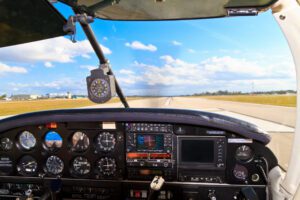
Eddie Ripper – then aged 27 – had completed his pre-take off checks in the dual control Foxbat A22LS ultralight before lining up on Runway 35 at Bendigo airport.
The December 2017 flight test followed Eddie’s 40 hours flying under instruction and would allow him to fly solo and progress further in his Diploma of Aviation – Commercial Pilot Licence course, – a VET-FEE-HELP course – at the Box Hill TAFE.
Instructor – Bao Nguyen of SOAR Aviation – was in the right-hand seat and would conduct the flight assessment.
In light winds, full visibility and light cloud cover, Eddie applied full power through the throttle with his right hand ready to grip the control stick between the two seats.
As the aircraft accelerated down the runway, it drifted slightly left of the centreline, as can commonly and safely occur.
Nguyen applied right rudder to correct the run back towards the centreline without announcing that he was taking control. Almost simultaneously, Ripper also applied right rudder, compounding the control input and yawing the aircraft rapidly to the right.
Believing the aircraft was running out of runway and fearing it would leave the paved surface, Ripper pulled back hard on the control stick to lurch the Foxbat airborne.
The aircraft over-rotated into a nose-high attitude, producing a vibration and loud thud as the horizontal stabiliser struck a runway light 1.5 metres from the runway edge.
It staggered airborne, stalled, dropped its left wing and crashed nose-first into the runway.
Ripper was ambulanced to Bendigo hospital with injuries to his left leg, elbow and neck. More significantly, he developed post-traumatic stress disorder.
He subsequently developed an alcohol-misuse disorder that impaired his capacity to fly and effectively ended any realistic prospect of meeting the medical and psychological standards required for commercial flying, which put an end to his childhood ambition.
The trainee eventually obtained his private pilot’s licence in August 2019 after several false starts at resuming his course. He could not though finish the course and training to qualify as a commercial pilot. Since the accident he has worked in the car industry and in finance.
Ripper filed a lawsuit against the corporate owner of SOAR in 2019 for injury compensation principally for the difference between the income he would have received as a commercial air pilot and that he could expect to get in a finance job.
He argued that he had been injured because the instructor had assumed control of the Foxbat without warning thereby breaching fundamental training protocols designed to ensure that only one pilot manipulates the controls at any one time.
SOAR on the other hand, contended that the accident was solely the result of Ripper’s error in pulling back on the control stick when the aircraft could not and should not have become airborne. The instructor’s rudder input was either minimal or irrelevant – it argued – and any over-rotation was entirely the student’s fault.
The trial judge found neither Ripper nor Nguyen to be impressive witnesses. Ripper “tried to fill gaps in his memory in ways designed to best suit his case.” Nguyen “obfuscated and failed to make sensible concessions when asked reasonable questions”.
The case therefore turned on corroboration, contemporaneous records, expert evidence and the inherent logic of events. Notes made shortly after the accident recorded that the aircraft had run off to the right and struck a runway light. Photographs showed damage consistent with a tailplane strike at the runway edge.
Expert evidence during the 12 day trail established that, at take-off speeds, a light aircraft could traverse the width of the runway in about a second, leaving little opportunity for conscious corrective action.
The court accepted that Nguyen had applied right rudder without communicating a transfer of control, and that this unannounced intervention created a dangerous situation. Ripper’s instinctive response—pulling back to get the aircraft airborne—was found to be foreseeable in circumstances where he had not been trained in aborted take-offs and believed he was about to run off the runway.
Although the final control input was physically made by Ripper, the court held that the causal chain began with the instructor’s failure to communicate.
SOAR’s insurer appealed.
The appeal judges upheld the finding that uncoordinated control inputs, arising from a failure to follow handover procedures, caused the aircraft to veer right, over-rotate and crash.
Eddie gets to keep the damages awarded to him by Judge Robertson in the County Court including $150,000 for general damages.
Although satisfied Ripper would have worked as a commercial pilot but for the accident, Judge Robertson reduced loss of income damages by 50% to account for the risk he might not have completed training or that he might not have obtained such a job.
She therefore assessed $76,000 for past income loss; and $561,000 for reduction in future earning capacity, making up a total award of nearly $800,000.
Gobel Aviation Pty Ltd (in liq) v Ripper [2025] VSCA 344 Niall CJ, Beach JA and O’Meara AJA, 23 December 2025
Categories: aircraft accident